
On July 6, Beijing time, OpenAI product lead Thibault Sottiaux publicly confirmed that the Ultra version of the next‑generation flagship model GPT‑5.6 Sol will be officially integrated into Codex. This follows earlier sightings of related identifiers in Codex’s codebase, and the official statement finally puts an end to speculation.
The addition of Ultra mode positions Codex to become the most powerful coding assistant for developers, prompting many to exclaim, "Maybe we won’t need to pay for Claude anymore."
Performance tops the charts
In the Terminal‑Bench 2.1 evaluation of end‑to‑end coding ability, GPT‑5.6 Sol scored 88.8% in standard mode, surpassing Claude Mythos 5’s 88.0%; with Ultra mode enabled, the score surged to 91.9%, setting a new state‑of‑the‑art among all public models.
Ultra mode coordinates multiple sub‑agents to collaboratively advance complex, long‑horizon tasks, and together with the Max reasoning intensity setting, it gives the model more thorough deliberation time.
In specialised domains such as cybersecurity and genomics, Sol also outperforms its predecessors and competitors with fewer tokens, demonstrating remarkable efficiency.
Three models with clear positioning
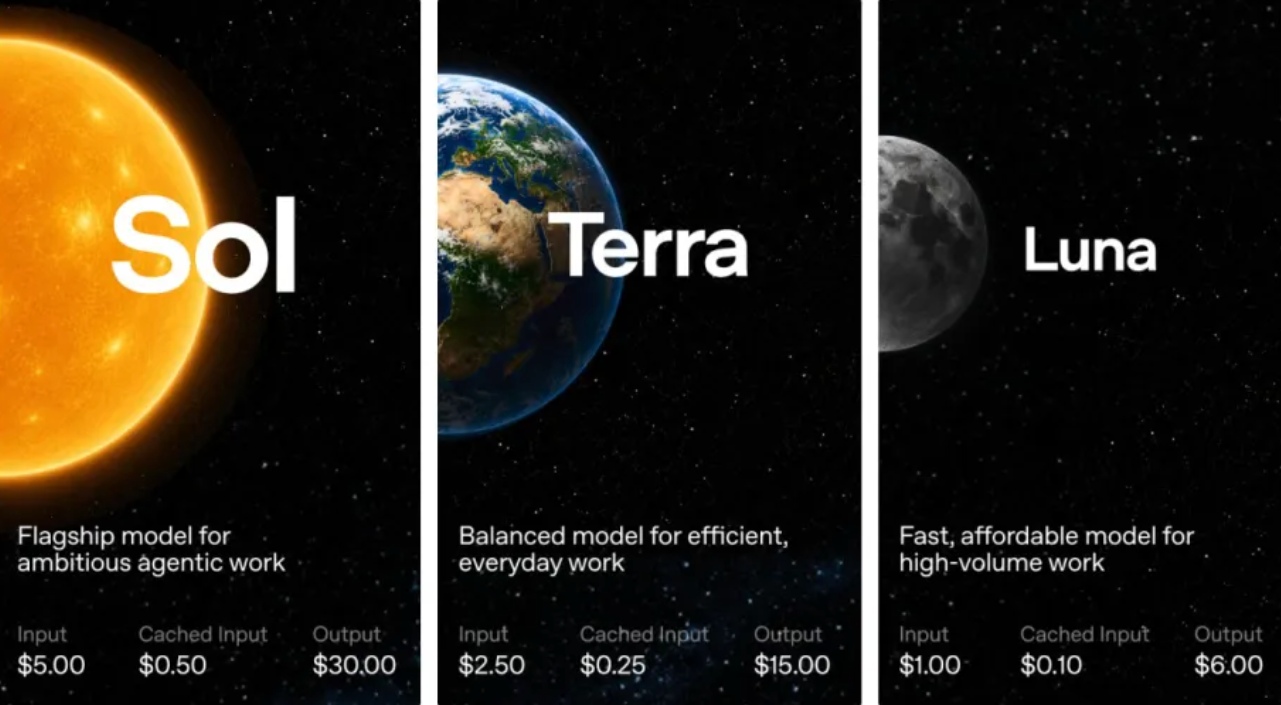
GPT‑5.6 series adopts a three‑tier astrophysics‑inspired naming system – Sol, Terra, Luna – each independently iterated and clearly positioned.
The flagship Sol is priced at $5 per million input tokens and $30 per million output tokens, designed for cutting‑edge reasoning, complex algorithm design, and security research – the most demanding scenarios for performance‑hungry developers.
The balanced Terra, at $2.5 input and $15 output per million tokens, delivers performance on par with GPT‑5.5 but at half the cost, making it the value champion for most everyday development and production environments.
The lightweight Luna costs only $1 input and $6 output per million tokens, tailored for high‑frequency batch tasks and lightweight automation, handling massive code generation and data processing at minimal expense.
Together, the three models cover the entire spectrum from cutting‑edge research to large‑scale engineering, allowing developers to flexibly choose based on project needs. The new line also introduces a more flexible prompt caching mechanism with explicit cache breakpoints, significantly reducing the cost of repeated calls.

Limited preview and full rollout approaching
Currently, the GPT‑5.6 series is in limited preview, available only via API and Codex to select partners and not yet in ChatGPT.
OpenAI said it plans a full rollout across ChatGPT, Codex, and the API in the coming weeks. Sources indicate the internal public release window is locked for July 7, precisely capitalising on a vacuum left by the expiration of a specific Claude plan – and combined with recent negative moves from Gemini and Claude, this is seen as a well‑timed strategic play.
For developers, the arrival of GPT‑5.6 Sol Ultra means they can now access top‑tier coding ability directly in Codex, without paying extra for other models. As OpenAI puts it, "We believe in broad accessibility" and this is only the beginning.