
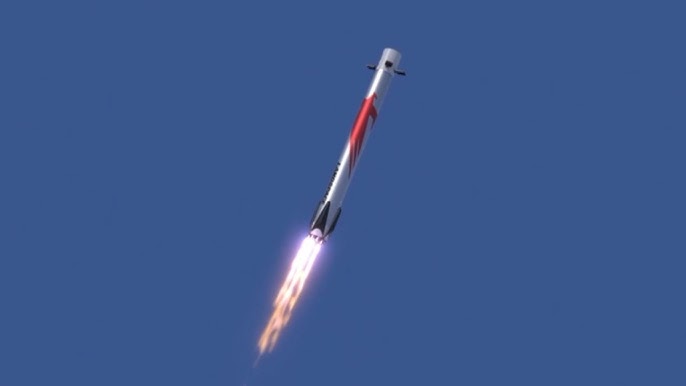
At 07:35 on August 19, 2026, the Zhuque-3 Y2 launch vehicle lifted off from the Dongfeng Commercial Space Innovation Test Zone. The second stage delivered the Honghu-03 satellite to its target orbit, while the first stage flew back to the landing zone on a pre-programmed trajectory and touched down on its landing legs. The mission was a complete success.
It marks the first time China has recovered a reusable launch vehicle's first stage using landing legs, and the first liquid-propellant rocket recovery by a Chinese commercial launch company. A barrier the industry has been pushing against for years has now been cleared.
A rocket built for reuse
Zhuque-3 is a next-generation liquid oxygen and methane launch vehicle approved by the China National Space Administration, designed around four goals: low cost, high payload capacity, high launch cadence, and reusability.
The vehicle uses a single-core, two-stage tandem configuration. It stands 66.1 meters tall, with a 4.5-meter diameter on both stages and a 5.2-meter payload fairing. The primary airframe structure is built from stainless steel, and the tanks are arranged with the fuel tank above the oxidizer tank to optimize the vehicle's center of mass in flight.
The first stage is powered by nine Tianque-12A liquid oxygen and methane engines, throttleable across a range of 40% to 110%. That throttle range is what makes vertical recovery possible at all: the engines have to be able to dial thrust far enough down for a booster weighing tens of tons to decelerate and hover as it approaches the ground.
Methalox propellant, a stainless steel airframe, vertical recovery. Those three choices define the technical path Zhuque-3 committed to, and today's flight validated the full stack end to end.
Getting up was never the hard part
The difficulty in a reusable rocket is not going up. It is coming back and landing precisely.
Zhuque-3 cleared several engineering hurdles on this flight. The landing propulsion scheme was simplified, cutting the number of engines that need to relight and reducing overall system complexity. The safety control strategy was upgraded with a new predicted-impact-point range safety function, improving the safety margin during recovery. And the second stage engine nozzle expansion ratio was increased, unlocking additional payload capacity.
Satellite separation also got new hardware. The rocket flew a self-developed stacked clamp-and-release mechanism with a dual-redundancy design intended to guarantee reliable separation of multiple satellites at once. That capability maps directly onto the demands of batch constellation deployment.
Zhuque-3 was approved in August 2023. Three years later, in August 2026, it has put a second stage into orbit and brought a first stage home. That pace is rare anywhere in the commercial launch business.
The cost math: the first stage is 70% of the rocket
Why is the entire industry fixated on recovery? The answer sits in the cost structure.
According to the program's chief designer, liquid oxygen and methane propellant typically accounts for just 1% to 3% of launch cost, while the first stage accounts for roughly 70% of the cost of the entire vehicle.
Put plainly: the fuel you burn is close to free, and the hardware you throw away is where the money goes. Every additional reuse of a first stage pushes the per-launch cost down another step. That is why reusability rewrites the economics of commercial spaceflight rather than merely improving them.
LandSpace says it plans to fly a reuse mission with the recovered booster as soon as possible, and to build out a closed loop of launch, recovery, inspection and reflight to support high-cadence, low-cost commercial operations. Recovery is only the first milestone. The real test is putting the same hardware back on the pad.
The launch capacity underpinning constellation buildout
The timing of this breakthrough matters.
In April 2026, China moved to strengthen planning and construction of the "six networks," including a next-generation communications network. In the opening year of the 15th Five-Year Plan, satellite internet on the payload side and reusable rockets on the launch side together form the foundation for an integrated space-air-ground-sea architecture.
Low-earth-orbit constellations are counted in the thousands of satellites. Under an expendable launch model, neither the cost nor the achievable launch cadence can support that scale. Industry analysts expect the validation of Zhuque-3's technical path to measurably accelerate China's LEO constellation deployment.
The China National Space Administration said it will continue to push reusable launch vehicles toward operational engineering deployment, strengthening the country's ability to reach orbit at high payload capacity, low cost and high frequency.
From reaching orbit, to recovering the booster, to reflying it — China's commercial space sector has just finished step two. Step three is now on the clock.