

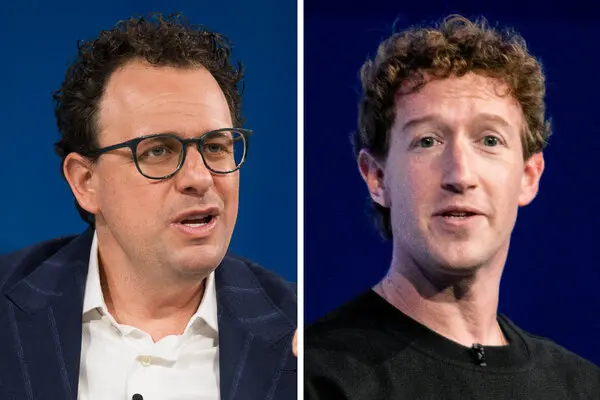
According to five people familiar with the two companies, Meta has become a heavy user of Anthropic’s artificial intelligence products, with its usage placing it among the AI startup’s largest customers. At one point this year, Meta internally estimated that its annual spending on Anthropic’s AI models could reach as much as $10 billion. That would represent a substantial portion of Anthropic’s revenue, which the company projected in July would exceed $65 billion on an annualized basis.
As recently as February, Mark Zuckerberg publicly accused AI labs of “seeking monopolistic power.” Yet Meta is now spending hundreds of millions of dollars each month on Anthropic’s tools.
This apparent contradiction—criticizing Anthropic while continuing to buy its products—captures the dilemma facing major technology companies in the current race to develop advanced AI models: progress on proprietary models has fallen short of expectations, even as their reliance on leading third-party systems deepens.
Talks Advance on a Separate $10 Billion Compute-Leasing Deal
The New York Times reported that Meta had at one point projected its annual spending on Anthropic’s AI models could reach $10 billion. In addition to these potential model-usage costs, the companies are discussing a separate computing agreement that could also be worth as much as $10 billion.
On July 18, The New York Times, citing three people familiar with the matter, reported that Meta was in talks with Anthropic over a two-year compute-leasing agreement valued at up to $10 billion. Anthropic proposed the arrangement in June, and Meta is evaluating it, although the talks may not ultimately result in a deal. If an agreement is reached, Anthropic would pay Meta monthly fees for computing capacity over the two-year period.
For Meta, the arrangement would represent an important effort to monetize its AI infrastructure. Renting its data center capacity to external customers could mark the company’s formal entry into the cloud computing market, putting it in more direct competition with Amazon Web Services, Microsoft Azure and Google Cloud.
For Anthropic, securing additional computing capacity ahead of a potential initial public offering could strengthen its pitch to public-market investors. People familiar with the matter said Anthropic is preparing for an IPO that could value the company at as much as $2 trillion and raise up to $100 billion.
Meta CEO Mark Zuckerberg has raised the company’s 2026 capital expenditure forecast to between $125 billion and $145 billion. With spending reaching such levels, leasing excess computing capacity is emerging as a potentially important way for Meta to ease pressure on its finances.
Rivals and Partners in the AI Race
Meta’s substantial spending on Anthropic illustrates the increasingly complex relationships within the generative AI ecosystem.
Even as Zuckerberg publicly criticized Anthropic for seeking monopolistic power, Meta’s proprietary Muse Spark model has yet to reach the industry’s top tier. As OpenAI, Anthropic and Google continue to improve their models, Meta has been forced to rely on leading external systems to support its portfolio of AI products. For now, Meta’s in-house models cannot fully replace the capabilities provided by Claude.
People familiar with the matter said Meta reduced some AI-related spending this summer. Nevertheless, the hundreds of millions of dollars it continues to spend on Anthropic each month suggest that the arrangement—using a rival’s models to power its own business—is unlikely to change until Meta’s proprietary technology catches up with the frontier.
Whether Meta’s projected annual spending will ultimately reach $10 billion remains uncertain. The figure was an internal estimate, not a contractual commitment. Even so, it underscores a broader reality in the global AI industry: relationships in which technology companies are simultaneously competitors, customers and partners are becoming increasingly common.
Criticism is one thing; business is another.
This article is provided for informational purposes only and does not constitute investment advice.