

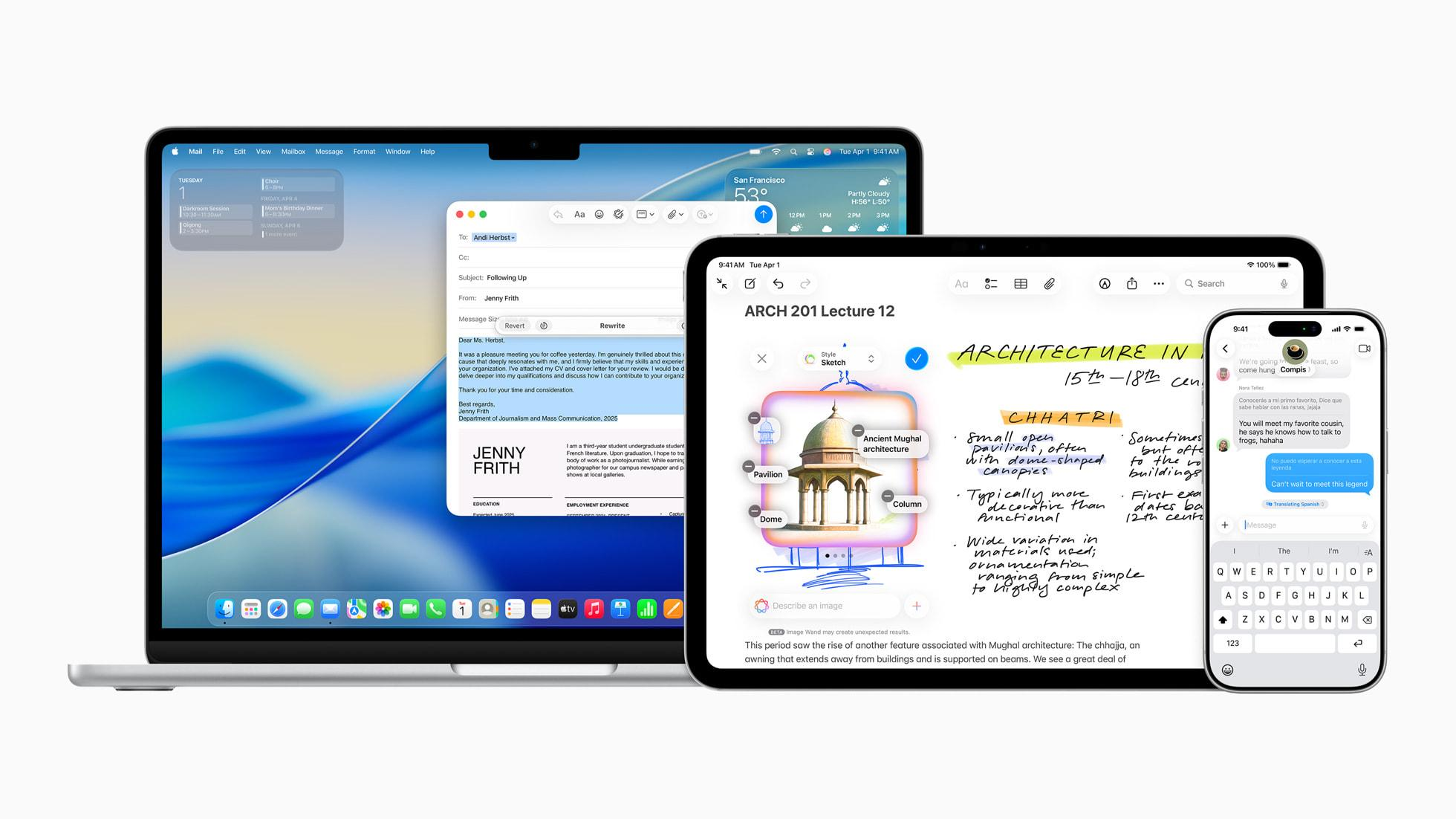
Apple Intelligence is finally moving closer to Chinese users.
On November 4, Apple opened developer testing for Apple Intelligence in mainland China. With the latest iOS developer beta, users can begin exploring features across Writing Tools, Visual Intelligence, Siri, and other system experiences. More importantly, Alibaba's Qwen model is now integrated into selected Apple Intelligence features, bringing local large language model capabilities into Apple's ecosystem.
The development comes nearly two years after Apple Intelligence first debuted internationally. For Apple, this is not simply a delayed feature release. It marks a significant adjustment in how the company approaches AI in the Chinese market.
Why Has Apple Taken Nearly Two Years to Bring AI to China?
 Apple Intelligence was first introduced in 2024, but its rollout in mainland China did not happen alongside other major markets. The delay was not simply a matter of technical adaptation. Generative AI services in China must meet local regulatory requirements, including those concerning service compliance and data processing.
Apple could not simply bring its overseas AI services into China unchanged. In particular, third-party models such as ChatGPT, which support certain Apple Intelligence experiences internationally, could not serve as a straightforward solution for the Chinese market.
In July 2026, Apple's generative AI services cleared an important regulatory milestone in China, paving the way for a potential launch. But regulatory approval alone was not enough. Apple still needed to establish a local AI service framework that could meet market-specific requirements.
This is where Alibaba becomes strategically important. Rather than building an entirely separate local AI service from scratch, Apple can work with an established domestic technology partner to accelerate deployment and reduce the complexity of localization.
Qwen Enters Siri but Apple Is Not Abandoning Its Own Models
The most significant aspect of this partnership is not that Qwen is replacing Siri. It is that Apple is adopting a more flexible approach to model collaboration.
Apple Intelligence will continue to be powered by Apple's own generative models, while Qwen will provide additional capabilities in selected scenarios.
For example, Siri can turn to Qwen when handling certain requests, allowing users to ask questions about photos and documents, including PDFs and presentations. Writing Tools can also use Qwen to generate original content from scratch, rather than being limited to rewriting, proofreading, and summarizing existing text.
Visual Intelligence further expands these capabilities, allowing users to identify objects and locations through the iPhone camera and seek additional information.
This division of responsibilities allows Apple to retain control over its operating system and user experience while bringing in external models to strengthen knowledge processing and content generation.
However, there is an important distinction: the next-generation Siri AI experience has not yet arrived in China. The current rollout includes existing Siri enhancements, but excludes the more advanced Siri AI capabilities and other next-generation features announced at WWDC 2026.
Apple Is Fighting for More Than AI Features
Over the past few years, Chinese smartphone manufacturers have increasingly integrated AI into their operating systems. From intelligent search and voice assistants to image processing and content generation, AI has become an important factor in product differentiation.
Apple, meanwhile, has struggled to keep pace in this area. The prolonged absence of Apple Intelligence in China has not only left users without certain system-level features but has also put the company at a disadvantage in the local AI ecosystem.
For Alibaba, the partnership carries its own strategic value. Qwen is no longer confined to a standalone application or web interface. Its integration into Apple's system-level experiences gives the model an opportunity to reach a much broader consumer base.
For large language model developers, being accessible through an operating system can be just as important as model performance itself. Competition is increasingly shifting from building better models to securing the interfaces through which people interact with AI every day.
Nevertheless, the partnership still has clear boundaries. Apple's initial rollout is limited to supported iPhones, with other platform support dependent on further approvals. The features are expected to reach Chinese users more broadly in December alongside the release of iOS 27.3.
What Apple is really doing is recognizing that a single AI model and partnership strategy may not work across every market. Its ability to retain control over the user experience while integrating local AI capabilities could determine whether it can regain momentum in China's increasingly competitive smartphone market.