

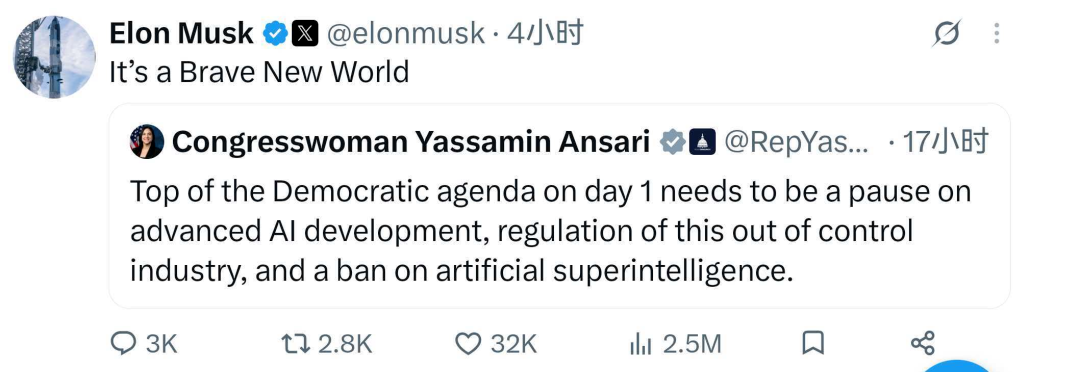
On November 4, U.S. Representative Yassamin Ansari publicly called for Democrats to prioritize pausing advanced AI development, regulating the industry, and banning artificial superintelligence (ASI) in the new Congress. The statement quickly drew attention. The following day, Elon Musk responded on social media with the phrase, "It's a Brave New World," referencing Aldous Huxley's dystopian novel to criticize the proposed policy direction.
The debate is not simply about how quickly AI should advance. When the U.S. begins considering criminal penalties, corporate asset seizures, and international export controls to restrict superintelligence research, the risks facing AI companies extend beyond technological competition. The question becomes how much freedom companies will retain to pursue advanced AI development.
Why Is a Bill That Has Yet to Pass Drawing So Much Attention?
 The proposal did not emerge overnight. On September 23, 2026, Senator Bernie Sanders introduced S.5493. The following day, Representative Greg Casar introduced its House counterpart, H.R.10538. Ansari is among the original co-sponsors of the House bill. Both carry the title Ban Artificial Superintelligence Act of 2026.
It is important to note that neither bill has passed Congress or become law. The House version was referred to the House Committee on Oversight and Government Reform, while the Senate version was referred to the Committee on Commerce, Science, and Transportation.
The latest political statements could give the proposals greater legislative attention, but they do not mean that a ban is already in effect.
The proposed legislation goes beyond prohibiting the development of a particular AI model.
It calls for the establishment of a dedicated federal AI regulatory agency to oversee advanced AI systems. Before the agency is fully operational and regulatory standards are established, certain advanced AI systems meeting specified computing thresholds would face restrictions on training, modification, fine-tuning, and deployment.
More significantly, the proposed restrictions extend into the upstream stages of AI research. Systems capable of substantially accelerating AI development, bypassing human oversight, independently improving their own capabilities, or assisting in the design of nuclear, biological, or chemical weapons could fall within the scope of regulatory scrutiny.
Regulators could require certain systems to cease operation, disconnect from the internet, or even be permanently shut down if their risks cannot be adequately addressed.
This means the proposed restrictions may cover not only fully developed superintelligent systems, but also research capabilities and technological pathways that could lead to them.
Behind the 20-Year Prison Sentence: A Fundamental Shift in AI Business Risks
One of the most striking aspects of H.R.10538 is the severity of its proposed penalties.
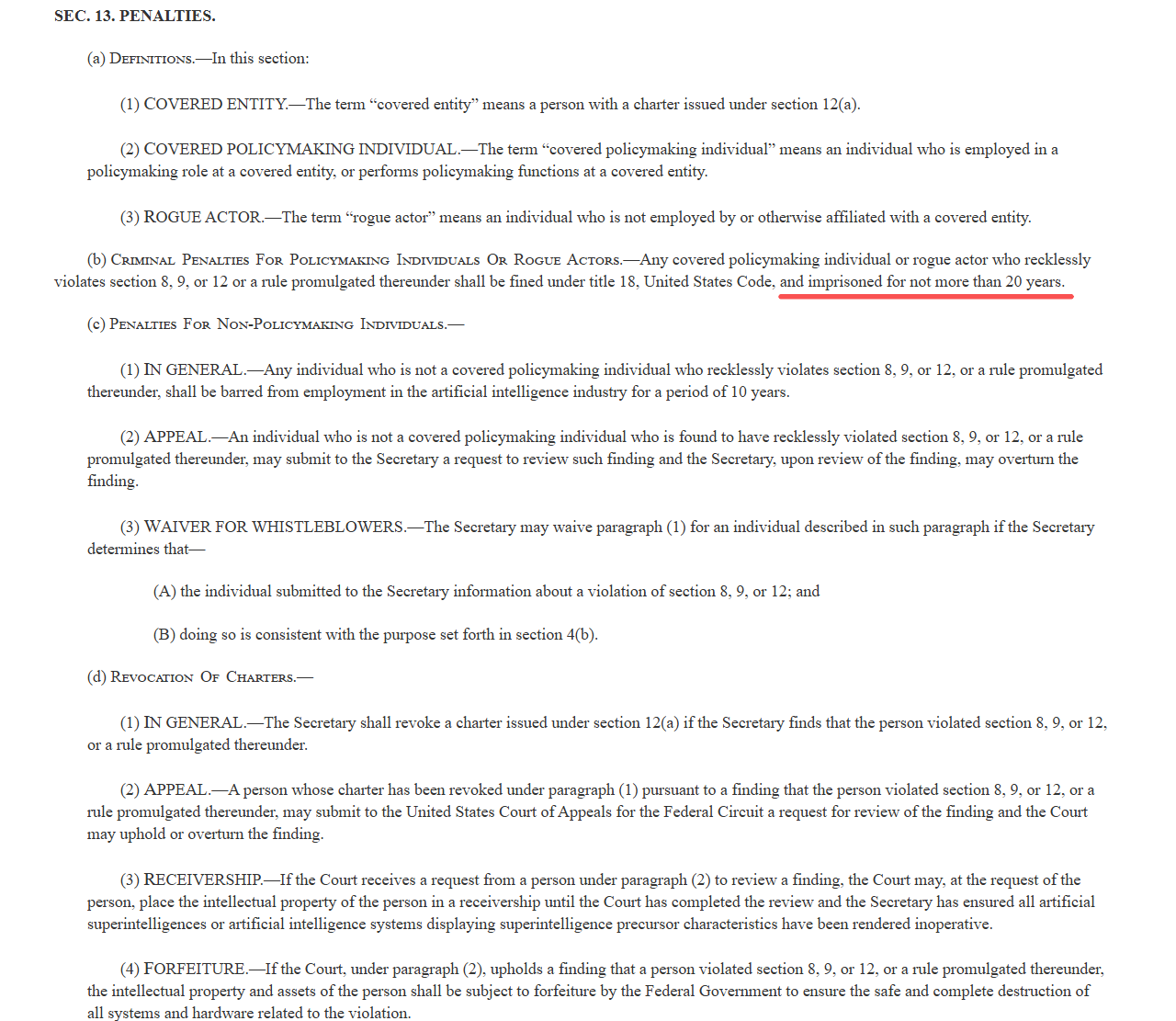
Individuals who recklessly violate the legislation could face up to 20 years in federal prison. For companies, violations could result in the revocation of development licenses. If the violation is upheld through judicial review, related intellectual property and assets could also be confiscated by the federal government for the purpose of destroying prohibited systems and associated hardware.
The impact goes far beyond conventional financial penalties.
AI development requires substantial long-term investment in computing infrastructure, chips, talent, and data. If a research project could ultimately lead to the loss of core intellectual property or critical assets, companies would have to reassess the legal risks of their development strategies.
For companies investing billions of dollars in data centers and frontier models, research decisions would no longer depend solely on technical feasibility and commercial returns.
For investors, the greater concern may not be regulation itself, but the inability to determine in advance where regulatory boundaries lie.
The Global Dimension: AI Restrictions Could Reshape the Computing Race
Another important aspect of H.R.10538 is its international scope.
The bill explicitly proposes making the global prohibition of artificial superintelligence a U.S. foreign policy objective. It calls for international agreements, coordination with allies, and export controls targeting relevant AI computing infrastructure.
If enacted, these measures could have consequences well beyond American borders.
The global AI industry relies on an interconnected supply chain. The U.S. holds significant influence over advanced chips, cloud computing platforms, and foundational AI research, while other countries continue investing heavily in computing infrastructure, model training, and AI applications.
Further restrictions on advanced chips, computing resources, and related technologies could affect not only American companies but also overseas research institutions that depend on U.S. technology.
From a national security perspective, Washington's concerns are understandable. AI systems capable of autonomous research, cyberattacks, or weapons design could create risks extending far beyond individual companies.
However, comprehensive restrictions could also produce unintended consequences. If American companies face increasingly strict limitations while other countries continue developing similar technologies, research and investment could shift toward jurisdictions with less restrictive regulatory environments.
This could weaken the competitiveness of U.S. companies while potentially reducing American regulators' direct oversight of advanced AI development.
Musk's Response Reflects a Deeper Divide Over the Future of AI
 Musk's reaction has attracted attention partly because he occupies a prominent position at the intersection of AI development and U.S. politics. As the founder of xAI, he is also directly involved in the competition surrounding advanced AI infrastructure and models.
The debate is therefore about more than technological safety. It also concerns who should have the authority to determine the pace and boundaries of AI development.
Supporters of strict regulation argue that AI capabilities could advance faster than existing governance systems can respond, making preventive restrictions necessary. Those opposing a broad development freeze worry that excessive regulation could suppress innovation and allow other countries to gain a technological advantage.
The fundamental disagreement is whether the risks of superintelligence should primarily be addressed by restricting research or through technical evaluations, safety testing, and accountability mechanisms.
The proposed legislation remains at an early stage, and significant legislative hurdles remain before it could reshape the U.S. AI industry.
Nevertheless, it signals a broader shift in the regulatory debate. AI oversight is moving beyond post-release safety requirements toward the research process, computing infrastructure, intellectual property, and international technology flows.
For AI companies and investors, the next major question may not simply be how much more capable the next generation of models will become, but whether companies will retain the freedom to develop them when technological breakthroughs intersect with national security regulations.