

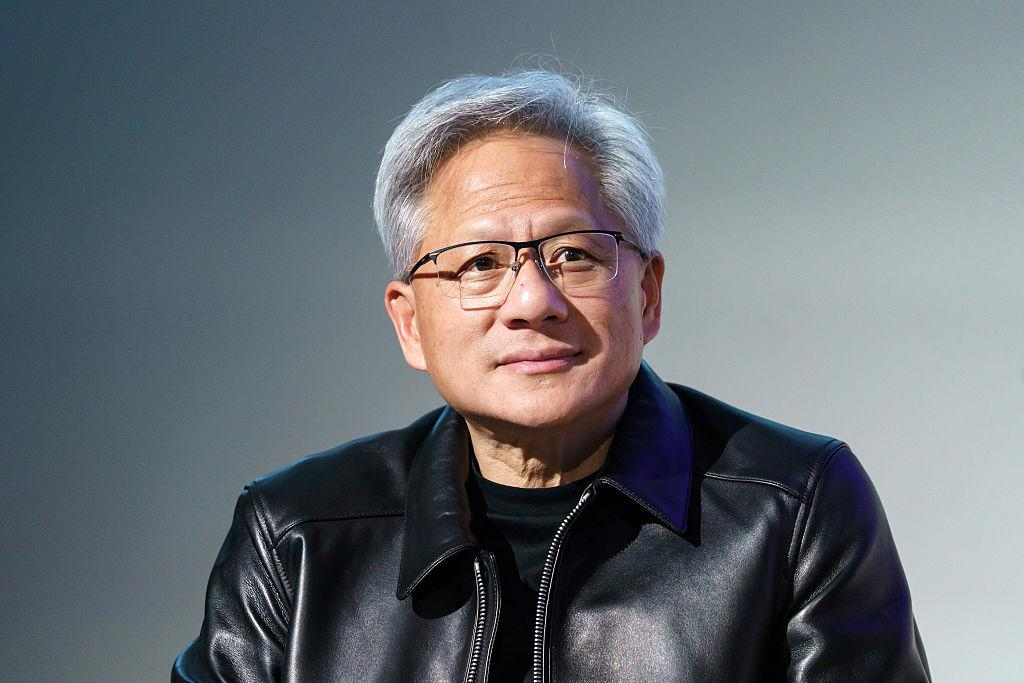
On November 8, Nvidia founder and CEO Jensen Huang sent an internal letter to employees, publicly acknowledging that he had been unfaithful to his wife and apologizing to his family, colleagues, and the company's board.
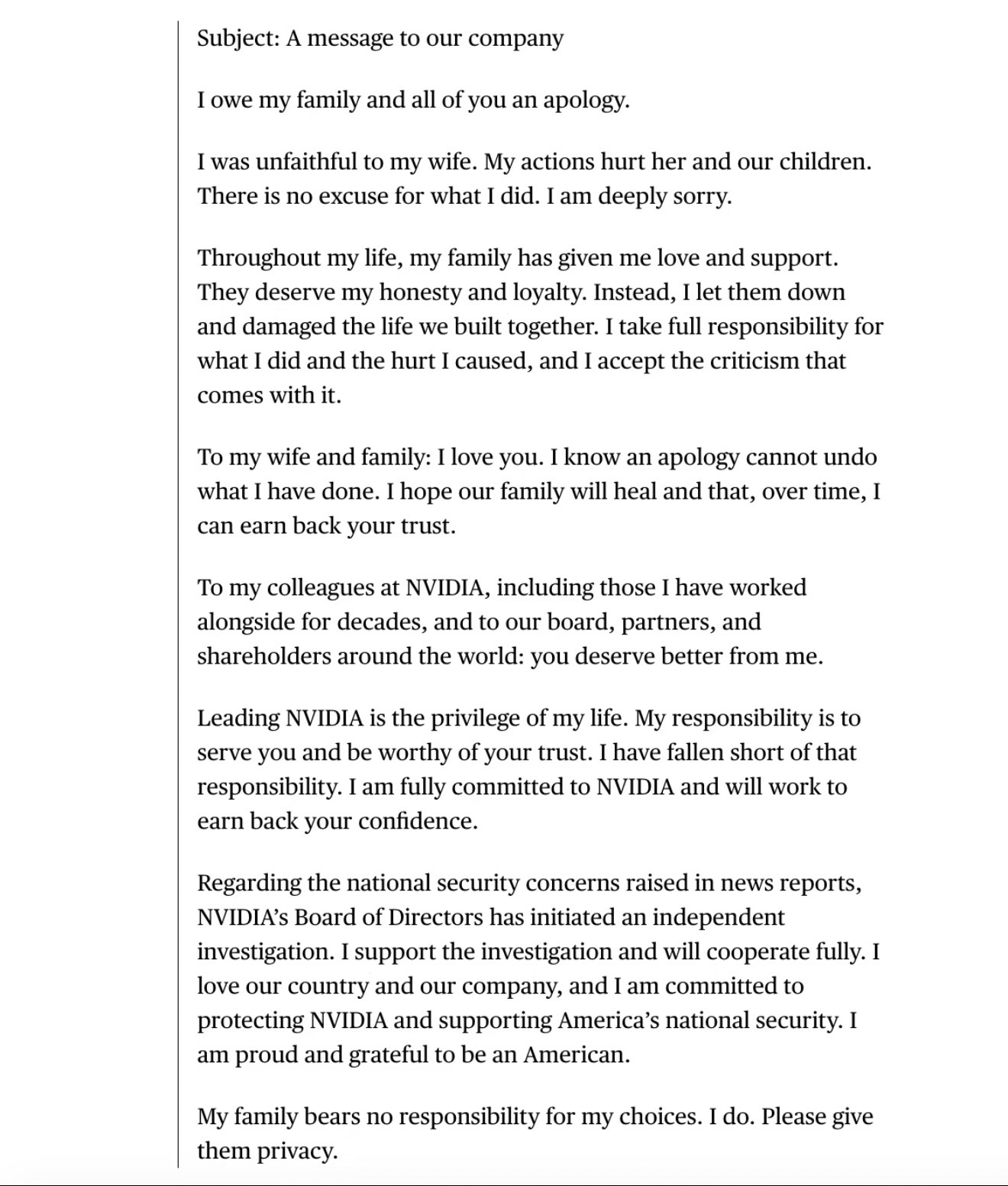 In the letter, Huang wrote: "I was unfaithful to my wife, and my actions hurt her and our children. There is no excuse for my behavior, and I am deeply sorry."
He acknowledged that he had betrayed the trust of his family, who had supported him throughout his career, and said he was prepared to take full responsibility for the damage caused. He also apologized to Nvidia employees, board members, business partners, and shareholders, saying they deserved better from their CEO.
Huang pledged to work toward rebuilding their trust and asked the public to respect his family's privacy.
The letter comes amid a separate controversy involving reports of potential foreign intelligence activity. Huang expressed support for Nvidia's independent investigation and said he would fully cooperate.
Why Has a Private Relationship Drawn the Attention of U.S. Intelligence Agencies?
 This incident is no longer just a marital controversy involving a senior corporate executive.
The New York Times previously reported that U.S. intelligence agencies were investigating a Chinese national executive named Alice Huang. She had worked at Megaspeed, a company that is a customer of Nvidia, and was suspected of having links to Chinese intelligence agencies and potentially attempting to obtain information related to advanced U.S. AI chips.
The report also alleged that Huang had an intimate relationship with Jensen Huang. It is important to note that the allegations concerning her intelligence ties and specific activities have not been substantiated by any publicly released investigative findings. The media reports should therefore not be treated as established facts.
These reports have now drawn a direct connection between Jensen Huang’s internal letter acknowledging an extramarital affair and the previously reported national security concerns surrounding him.
On November 8, local time, Nvidia’s board officially announced an independent investigation. A committee comprising independent directors will oversee the process, with external legal counsel brought in to conduct a comprehensive review of reports suggesting that Huang may have been targeted by foreign intelligence activities.
Nvidia said in its announcement that there is currently no reason to believe U.S. national security or the company’s trade secrets have been compromised. However, the board will examine all available information. Jensen Huang has expressed support for the investigation and pledged his full cooperation.
Nvidia's Bigger Challenge: Commercial Security Meets Geopolitical Competition
The reason Huang's personal controversy has evolved into a corporate governance issue lies in Nvidia's position within the global technology industry.
Nvidia is no longer simply a semiconductor manufacturer. Its GPUs power a substantial portion of the world's AI training infrastructure, cloud computing systems, and data centers.
At the same time, U.S. restrictions on advanced semiconductor exports have placed the company at the intersection of commercial competition and national technology policy.
As a result, Nvidia's customer relationships, chip distribution channels, and access to sensitive business information carry implications beyond ordinary commercial transactions.
There are three broader risks worth examining.
First, customer relationships can become a potential information-security vulnerability.
Nvidia maintains relationships with numerous global customers and business partners. Contact between a CEO and customer executives is a normal part of business. However, when personal relationships overlap with commercial interests, potential conflicts of interest and weaknesses in information controls may emerge.
For a company controlling some of the world's most important AI computing infrastructure, these risks require formal oversight rather than reliance on individual judgment.
Second, U.S. export controls are fundamentally changing the way semiconductor companies operate.
In the past, chip sales were primarily driven by customer demand, orders, and market share. Today, the ultimate destination of advanced chips, their end users, and the entities behind transactions can all become subjects of regulatory scrutiny.
Companies must therefore manage not only traditional commercial risks but also cross-border compliance and geopolitical exposure.
Third, dependence on a powerful founder can create corporate governance challenges.
Huang is not only Nvidia's CEO but also a central figure in its technology strategy, commercial relationships, and long-term direction.
A founder's judgment can be a significant competitive advantage. However, when personal conduct potentially intersects with commercial or national security concerns, the company needs independent oversight and effective internal controls.
This is one reason why Nvidia's board has chosen to establish an independent committee rather than leave the matter entirely to internal management.
The Investigation Could Determine the Real Impact on Nvidia
Nvidia's board has stated that it continues to have confidence in Huang and the company's management team. Huang will remain CEO and continue leading the company's operations while the investigation proceeds.
However, external scrutiny is continuing.
According to previous reports, Republican leaders of several U.S. congressional committees, including those overseeing foreign affairs, intelligence, and China-related issues, have requested that Huang attend a closed-door briefing on November 18 to discuss the relevant business relationships and Nvidia's security safeguards.
This means the controversy could extend beyond Nvidia's internal investigation and become part of a broader congressional review.
For investors, the most important question is not simply how much Huang's personal reputation may suffer. It is whether the investigation uncovers weaknesses in corporate controls, whether any confidential business information was exposed, and whether the findings could affect Nvidia's customer relationships or international operations.
The AI industry is entering a more complicated phase: controlling advanced computing power brings not only technological and commercial advantages, but also greater security responsibilities.
An apology letter can address personal conduct, but it cannot replace a company's responsibility to demonstrate that its business operations remain secure.
For Nvidia, the next critical step is to establish the facts and demonstrate that one of the world's most influential AI companies has the governance and risk-management systems needed to operate in an increasingly sensitive geopolitical environment.