

On July 6, 2026, Alibaba’s Tongyi Qianwen announced an upgrade to its real‑time speech recognition foundation model, Fun‑ASR‑Realtime. As a streaming ASR model, Fun‑ASR‑Realtime achieves breakthroughs in both speed and accuracy—first‑word latency is kept within the hundred‑millisecond range, so text begins to appear almost instantly after speech ends.
Recognition accuracy approaches that of offline models, and a single model supports 30 languages and 16 Chinese dialects. The model’s API is now officially available on Alibaba Cloud’s Bailian platform.
Sub‑100‑ms Response Proven in a 100‑Hour Island Survival Livestream
Speech recognition models are divided into offline and real‑time categories: offline models process pre‑recorded audio in one go and offer higher accuracy, while real‑time models transcribe on the fly and must balance accuracy and speed—a more challenging technical task.
Fun‑ASR‑Realtime achieves a first‑word latency of just hundreds of milliseconds, with equally low latency for long‑sentence tail‑word output.
During the “Return to the Desert Island” 100‑hour livestream produced by the Chinese creative team Yingshi Jufeng, which concluded on July 2, Fun‑ASR‑Realtime powered the entire real‑time captioning system. Despite challenging outdoor conditions—including heavy rain, two‑island interactions between multiple participants, and frequent speaker switches—the model ran stably, generating over 60,000 subtitle entries totaling 1.32 million Chinese characters.
Audiences were able to see on‑screen captions instantly, significantly enhancing the viewing experience.

(100‑hour livestream produced by the Chinese creative team Yingshi Jufeng)
Context‑Aware Understanding Enables Intelligent Real‑Time Error Correction
To address the common issue of fragmented interpretation in streaming recognition, Fun‑ASR‑Realtime has been specifically enhanced for broad contextual awareness (including historical dialogue context and real‑time hotwords). This gives it the ability to perceive context and dynamically correct errors. For example, during the island livestream, when a guest mentioned the bird “yèlù” (night heron), the model initially misrecognized it as “yèlù” (a different homophone), but as soon as the subsequent context—"as birdwatchers would know"—was processed, the model automatically corrected the transcription.
Leading Performance Across 16 Dialects
In multilingual and dialect recognition, Fun‑ASR‑Realtime stands out, supporting 30 languages and 16 Chinese dialects. In benchmark tests covering 16 dialects across China’s eight major dialect regions, the model achieved an average character accuracy of 88.62%, outperforming competing products from Volcano Engine and Tencent in 12 of the dialects.
Notably, it delivered impressive results in the challenging Wu dialect group: Shanghai dialect accuracy reached 92.41%, Suzhou dialect 89.21%, and even the notoriously difficult Wenzhou dialect achieved 82.74%. The model also demonstrated clear leadership in complex dialects such as Fujianese and Hakka.
In five benchmark scenarios for industrial Chinese and English speech recognition—covering noisy backgrounds, far‑field environments, and accented speech—Fun‑ASR‑Realtime achieved average character accuracy of 88.42% and 91.58%, respectively.
The model has also been specifically optimized for Southeast Asian languages such as Thai, with recognition accuracy improved by about 20%, making it suitable for cross‑border customer service, international conferences, and similar use cases.
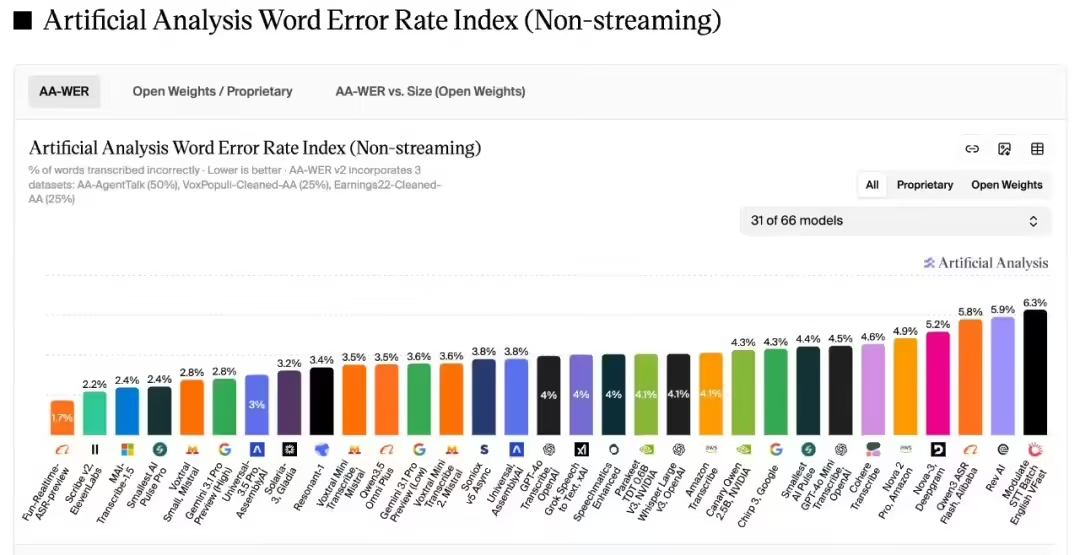
Offline Version Tops Global Rankings
Alongside the real‑time model, the offline version—Fun‑ASR‑Flash—has also been released. On the global AI evaluation platform Artificial Analysis’s word error rate leaderboard, Fun‑ASR‑Flash ranks first worldwide with a CER of just 1.7%.
APIs for both models are now live on Alibaba Cloud’s Bailian platform. In addition, the underlying FunASR open‑source framework and ecosystem models are available on ModelScope and GitHub.