

Ant Lingbo today unveiled LingBot‑VLA 2.0, its next‑generation embodied foundation model, whose core breakthrough is “one brain, multiple bodies”.
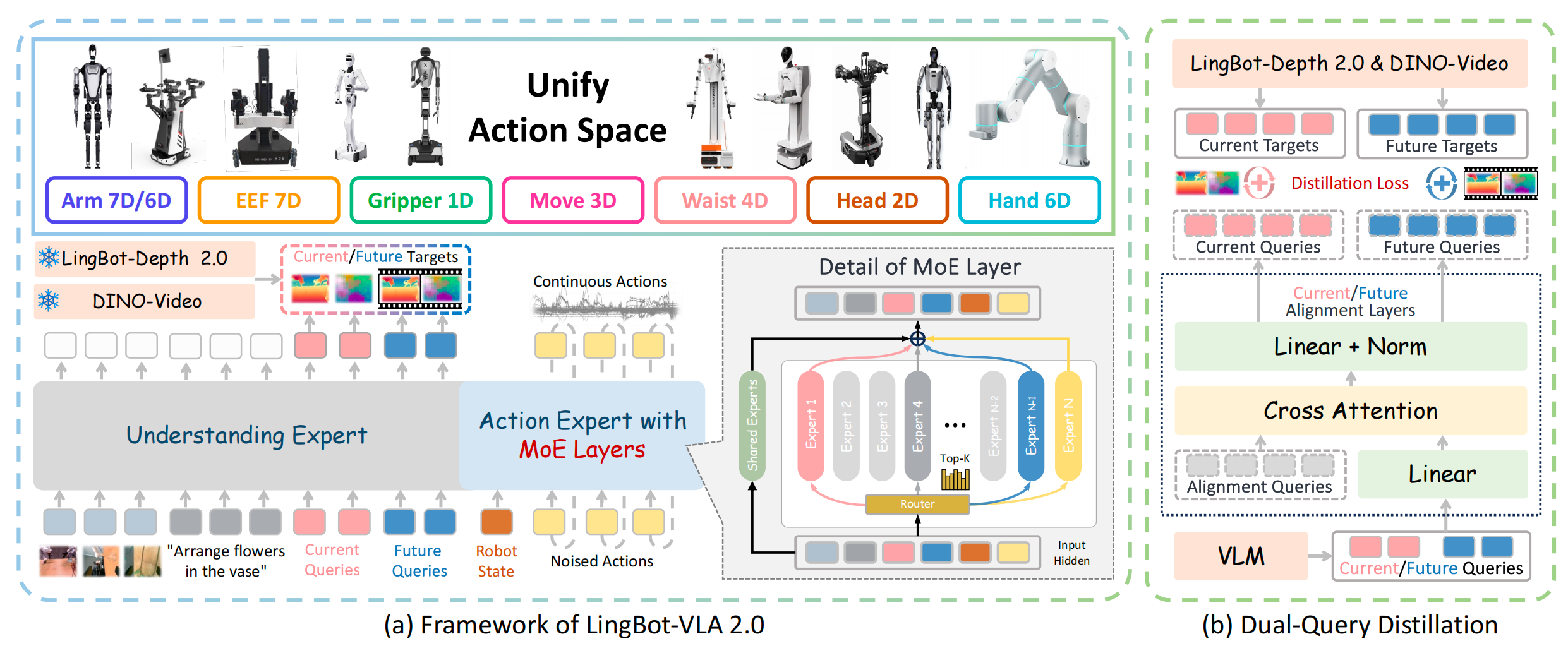
It supports 20 robot configurations from 17 manufacturers across single‑arm, dual‑arm, wheeled, and bipedal morphologies. Beyond manipulators, the action space now extends to full‑body degrees of freedom, covering the head, waist, end‑effectors, and mobile bases.
VLA: From Lab to Real-World Scenarios
Vision-Language-Action(VLA) is one of the most closely watched technical approaches in embodied AI in 2026. With new models successively launched by companies such as NVIDIA and Physical Intelligence, the industry is gradually reaching a consensus: for robots to operate in open environments, visual understanding, language instruction, and action generation must be integrated within a single unified framework.
However, when robots move from the lab to real-world settings—table heights change, object positions shift, and adapting to a different robot embodiment requires reconfiguration—many VLA demos that work under specific conditions still fall noticeably short in terms of stable execution, cross‑embodiment generalisation, and low‑cost deployment.
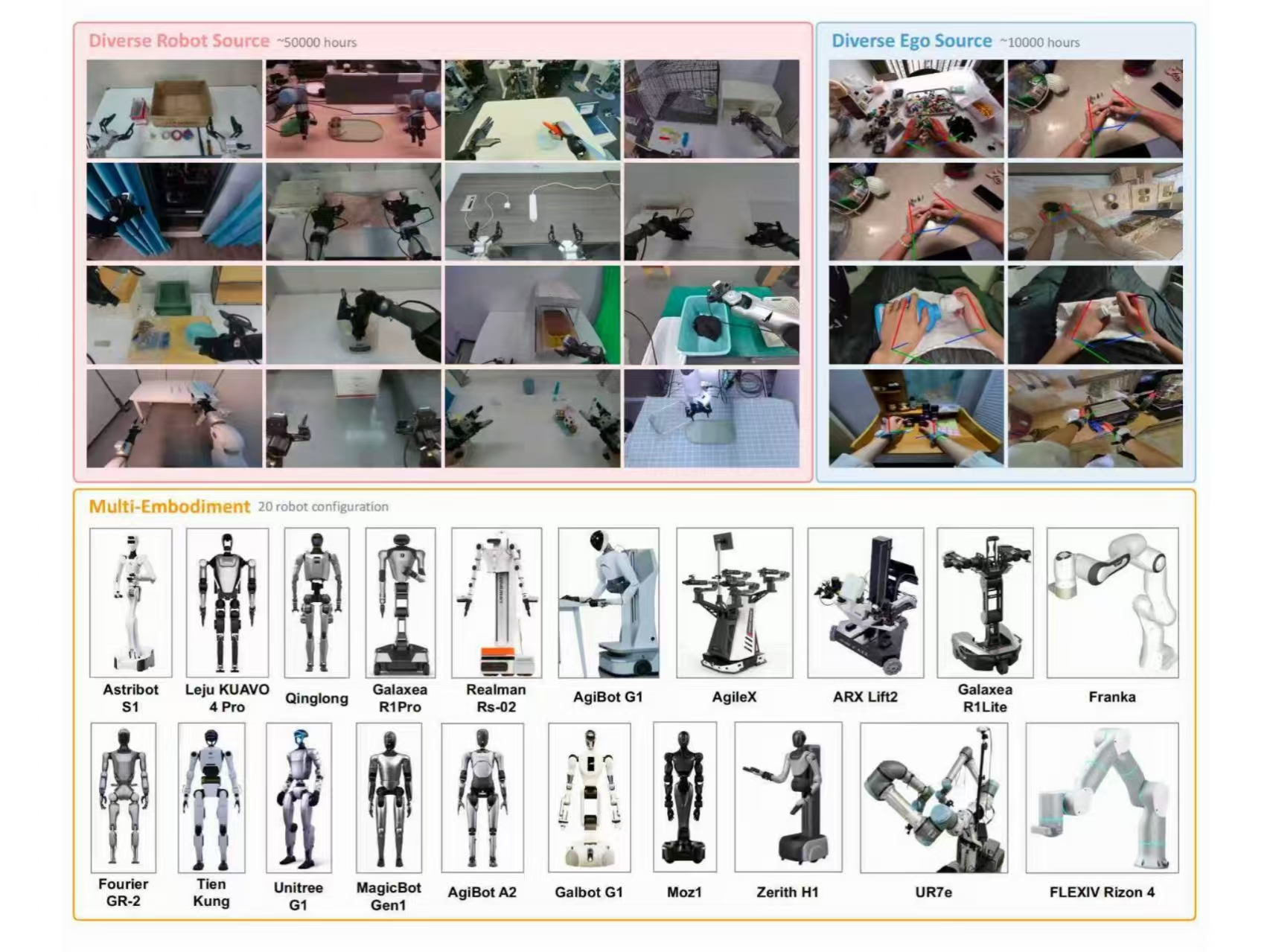
20 Embodiments, Full‑Body Degrees of Freedom, 60,000 Hours of Data
On the data front, the team curated 50,000 hours of high‑quality real‑robot data from 90,000 hours of raw recordings, and distilled 10,000 hours of effective data from 20,000 hours of first‑person human operation videos, resulting in a total pre‑training dataset of 60,000 hours. At the architecture level, the model incorporates MoE (Mixture of Experts) to handle the heterogeneity of multi‑embodiment data, enabling both general capabilities and embodiment‑specific characteristics to be modelled simultaneously within the same framework.
The model also introduces future prediction capabilities, allowing it not only to understand the current visual scene when generating actions but also to anticipate the evolution of task states. Taking refrigerator organisation as an example—where the robot needs to perform a continuous sequence of moving, opening the door, grasping, and placing—future prediction helps reduce deviations and interruptions midway.
In terms of spatial perception, the model integrates its proprietary LingBot‑Depth capability through a dual‑query distillation framework that learns from two teacher models: LingBot‑Depth provides geometric supervision, enabling the model to acquire depth and spatial structure information, while DINO‑Video supplies causal temporal video representations to help understand how states and spatial relationships evolve over time.
Leading Benchmarks Across Multiple Metrics
On the Shanghai Jiao Tong University GM‑100 evaluation suite, LingBot‑VLA 2.0 outperforms GR00T N1.7 and π0.5 in both average task progress score and success rate on two dual‑arm platforms: AgileX Cobot Magic and Galaxea R1 Pro.
In mobility tests, using two configurations—the Ark manipulator with Songling chassis, and Astribot S1 from Star Century—the model also maintains a lead over π0.5 in long‑horizon mobile manipulation tasks, with advantages in task progress score and success rate, and sustains its edge in cross‑domain scenarios.
Ant Lingbo continues the open‑source strategy from the previous generation, releasing model weights, training code, and technical reports all at once, available on Hugging Face and ModelScope. The concurrently open‑sourced efficient post‑training version achieves inference latency within 130 milliseconds on an RTX 4090, significantly reducing the adaptation cost for new tasks, new scenarios, and new embodiments.
Cross‑Embodiment VLA Moves Toward Engineering Maturity
The technical pathway of LingBot‑VLA 2.0 reflects a broader trend: the deployment of cross‑embodiment VLA requires not just larger models, but also the synergistic support of data engineering, unified representation, sparse architectures, spatiotemporal supervision, and post‑training systems.
In the past, the value of a VLA model was often judged by whether it could accomplish a single point task; today, the evaluation criterion is shifting toward whether there is a scalable, reproducible, and deployable end‑to‑end pipeline behind it.
The capabilities of a general‑purpose embodied brain must ultimately be repeatedly validated across different robot embodiments and real‑world tasks. The continued evolution of cross‑embodiment VLA depends precisely on these foundational components that determine whether a model can truly run in practice.
For developers and industry users, a single model that works across 20 different embodiments means deployment cycles shrink from months to weeks or even less. This open‑source framework is expected to lower the barrier to entry for embodied AI, enabling more small and medium‑sized teams to participate in the application development of cross‑embodiment robots.