

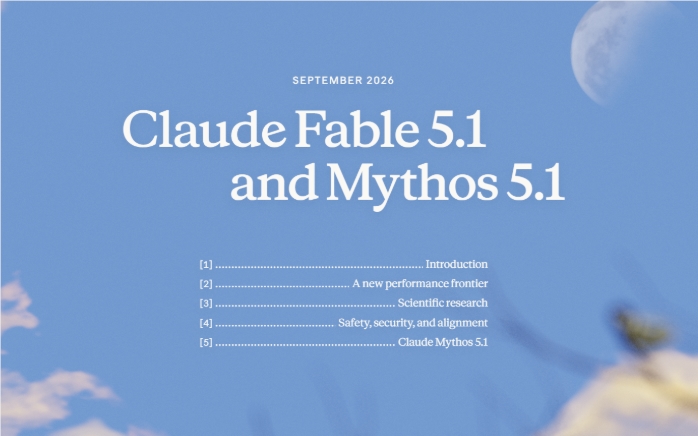
On September 2, Anthropic officially launched its next-generation flagship AI model, Claude Fable 5.1, along with its restricted-access version, Mythos 5.1. The new models outperform their predecessors across multiple benchmarks, while a major reduction in cache-read pricing cuts the cost of long-running tasks by as much as 45%.
Performance Focused on Long-Running Agent Tasks
Fable 5.1 and Mythos 5.1 are built on the same underlying model, with the main difference being their levels of safety restrictions. The biggest improvements in the new models are concentrated on long-running AI agent tasks that require continuous operation over extended periods.
In the Terminal-Bench-Science 0.1 benchmark for research agents, Fable 5.1 scored 52.6%, more than double Fable 5’s 24.7%.
In the agentic coding benchmark Terminal-Bench 4.0, Fable 5.1 achieved 55.8%, while the more capable Mythos 5.1 reached 60.9%.
The new models also performed strongly on benchmarks for business automation, including AutomationBench, as well as browser-based agents tested by Browserbase.
Early customer cases further demonstrate the models’ ability to handle long-running tasks. Ramp reportedly ran Fable 5.1 autonomously for 38 hours to complete a machine-learning task. Meanwhile, Browserbase recorded an 82% task-completion rate for Fable 5.1 on its most challenging browser-agent benchmark.
Pricing Shifts Toward a “Pay Per Task” Model
Anthropic is keeping Fable 5.1’s standard input and output token prices unchanged at $10 and $50 per million tokens, respectively.
The major change comes from cache-read pricing, which has been cut from $1 to $0.25 per million tokens, representing a 75% reduction.
According to Anthropic’s estimates, the new model’s overall cost is approximately 25% lower than Fable 5 under typical workloads.
For highly agentic tasks involving large amounts of context and frequent tool calls, the cost reduction can reach approximately 45%.
A Strategic Move Ahead of a Potential IPO
The launch comes at a critical moment as Anthropic prepares for a potential IPO.
Market reports indicate that the company has confidentially filed an S-1 registration statement and could potentially go public in the U.S. as early as fall 2026, with the offering potentially becoming one of the largest AI-related IPOs on record.
As Anthropic continues to push the boundaries of AI performance, its efforts to reduce the cost of long-running agentic workloads suggest a broader strategy: balancing technological leadership with commercial scalability and returns.
The move could help position Anthropic for sustained growth as it approaches a potential public listing.