

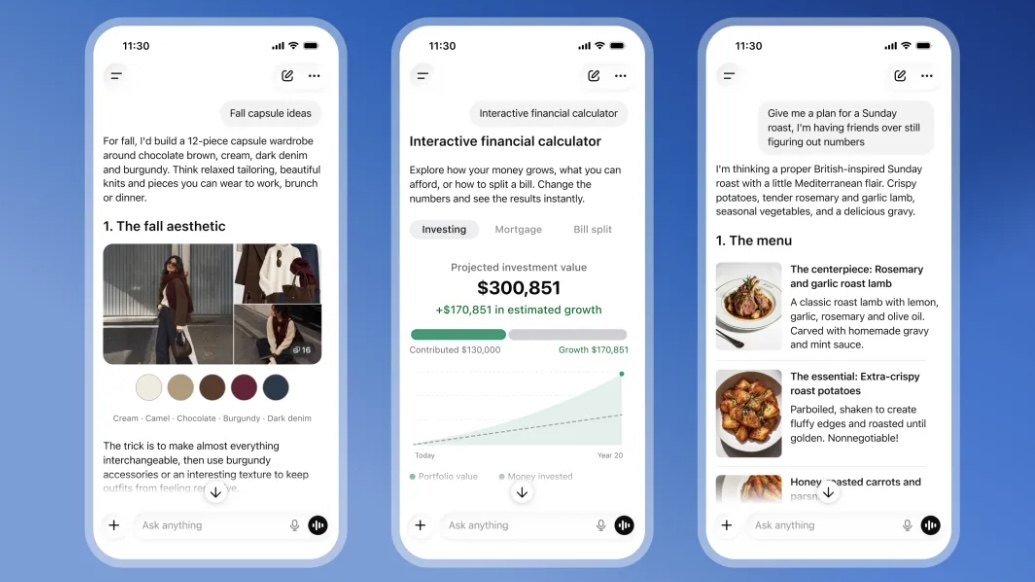
On October 7, OpenAI officially began rolling out GPT-6 to ChatGPT users worldwide, alongside a new feature called “Intelligent UI.”
The update means ChatGPT is no longer limited to answering every question through a text-based chat interface. Depending on the task, it can now generate charts, buttons, forms, calculators and even mini-games directly within a conversation.
The Key Shift: From “Chatting” to Generating Interactive Interfaces
OpenAI describes Intelligent UI as a significant shift in how people interact with ChatGPT.
Traditionally, users open a piece of software, learn how it works and then use it to complete a task. The new approach reverses that logic: users simply tell AI what they want to accomplish, and the AI generates an interface tailored to that specific task.
In an official demonstration, when asked how a seven-speed bicycle works, ChatGPT did more than provide a written explanation. It generated an interactive bicycle diagram that users could click to explore different components.
When asked how to play mahjong, ChatGPT visually organized different types of tiles to help users learn as they explored. For tasks such as calculating retirement savings or splitting a restaurant bill among friends, it generated adjustable calculators and bill-splitting tools. It could even create a retro-style mini-game directly inside the conversation.
“ChatGPT has largely been a text-based interface,” OpenAI Product Manager Aarush Selvan said during a media demonstration, adding that “the most helpful answer isn’t always just text.”
Under the Hood: A Component Library and Compiler That Render as the Model Generates
Intelligent UI is powered by a native library of streamable interface components together with a dedicated UI compiler.
As the model generates a response, it can call these components and decide how to combine text, charts, buttons and other interactive elements.
The compiler renders the interface progressively as it receives the model’s output, meaning users do not have to wait for the entire response to finish generating before interactive elements begin appearing.
GPT-6’s training process also introduced expanded evaluation criteria covering the clarity, usefulness and completeness of generated interfaces. The model was trained to determine when an interactive experience would be useful—and when a simple text response would be enough.
Another Upgrade: GPT-6 Can Start Answering While It Is Still Working
GPT-6 also changes the traditional “think first, answer later” model.
It can begin presenting information that has already been established while continuing to search, use tools and work through the remaining parts of a task in the background, dynamically adding to the response as progress is made.
According to OpenAI’s internal evaluations, for questions requiring web search, GPT-6 Instant begins responding an average of 44% faster than the previous generation.
Paid ChatGPT tiers—including Plus, Pro, Business and Enterprise—have been powered by GPT-6 Sol since October 7. Free and Go users are switching to GPT-6 Luna on October 8. Models used by Work and Codex are not included in this update.
According to CLS, the rollout reaches more than 1.2 billion weekly active ChatGPT users.
The Bigger Picture: Generative AI Is Moving Toward “Generative Interfaces”
Intelligent UI is not an isolated development. Google began testing similar “generative UI” capabilities in Search earlier this year.
*The Verge* described the update as turning ChatGPT into something that does more than answer questions—it can now generate interactive tools on the fly.
A *WIRED* reporter summarized the experience more simply: “Goodbye to the wall of text.”
“Previously, every question was forced into the same conversational format,” OpenAI wrote in its official blog. “Now, ChatGPT can combine interfaces, data and actions to create entirely new ways for people to explore, understand and interact with information.”
The shift from **generating content** to **generating interactive interfaces** is only beginning.