

Tech Giants Honored as AI Becomes a Strategic Priority
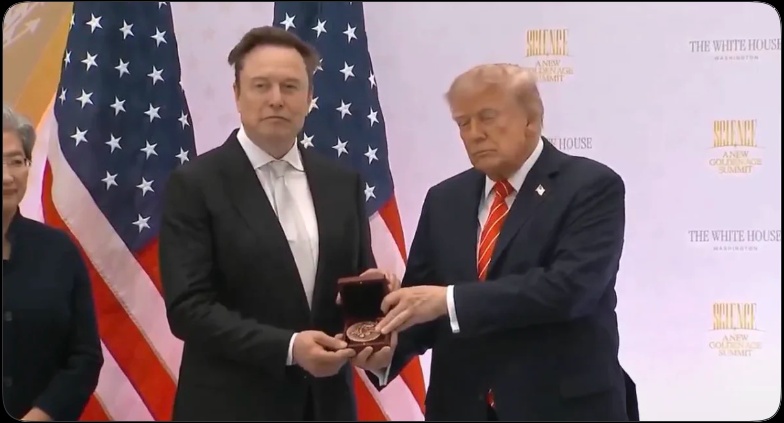
On October 8, 2026, U.S. President Donald Trump presented Elon Musk with the National Medal of Science at the “Science: A New Golden Age” summit held at the U.S. Institute of Peace in Washington, D.C. The ceremony drew public attention, with discussions extending to other technology leaders, including NVIDIA CEO Jensen Huang and AMD CEO Lisa Su.
As artificial intelligence becomes a central battleground in global technological competition, the significance of such an awards ceremony extends far beyond individual recognition.
Rather than focusing solely on who receives the medals, it is more important to examine the technological fields these figures represent, many of which have become key pillars of the U.S. technology industry.
It is worth noting that the National Medal of Science and the National Medal of Technology and Innovation are two distinct honors. The former recognizes achievements in scientific research, while the latter focuses on technological innovation. Details regarding recipients, award categories, and the context of the ceremony should be verified against official announcements.
From Chips to Space The Evolution of U.S. Technology Strategy
The most notable aspect of this group of honorees is that their work spans many of the critical infrastructure sectors underpinning America's technological competition.
Elon Musk represents commercial spaceflight, satellite communications, and intelligent systems. SpaceX is advancing reusable rocket technology and the development of space infrastructure, areas closely connected to the United States' broader space strategy.
Jensen Huang represents AI computing power. As generative AI advances rapidly, GPUs have evolved beyond their traditional roles in gaming and graphics to become essential infrastructure for training large AI models, running AI applications, and powering scientific computing.
Lisa Su represents semiconductor engineering and high-performance computing. AI progress depends not only on algorithms and models but also on chip architecture, advanced packaging, memory bandwidth, and computational efficiency. AMD's investments in high-performance processors and accelerated computing reflect this broader industry trend.
Meanwhile, Google co-founder Sergey Brin represents the enduring importance of information retrieval and data processing technologies. Michael Dell and Satya Nadella, recognized with technology and innovation honors, bring enterprise computing, cloud infrastructure, and AI deployment into the broader picture.
Although these fields may appear unrelated, they are increasingly interconnected. Chips provide computing power, data centers supply the infrastructure, AI models turn computing resources into capabilities, and commercial spaceflight and communications networks extend the boundaries of technological applications.
The United States is not simply emphasizing leadership in individual companies or technologies. It is pursuing a broader technological advantage spanning the entire stack, from foundational hardware to end-user applications.
Beyond the Awards The Policy Signals Matter More
The ceremony also coincided with the U.S. government's broader agenda to advance scientific research and artificial intelligence.
On October 8, the White House announced a series of science-related initiatives involving the federal government, private companies, academic institutions, and philanthropic organizations. The agenda included AI-assisted scientific research, advanced computing, and major research missions. The associated initiatives were reported to involve more than $6 billion.
This suggests that the U.S. government is seeking closer integration between the engineering capabilities of technology companies, private investment, and the federal research system.
For the AI industry, such collaboration could accelerate computing infrastructure development and provide additional resources for AI applications in energy, healthcare, space, and materials science.
However, this approach also raises important questions.
On one hand, the government aims to rely on technology companies to drive innovation. On the other, the allocation of research funding, the independence of public research institutions, and the ability of talent policies to attract leading researchers from around the world remain important factors shaping America's technological competitiveness.
The Washington Post has highlighted the contrast between the Trump administration's vision for technological innovation and concerns among some members of the scientific community about research funding cuts and the effects of immigration policies.
Ultimately, national honors can recognize technological achievements, but they cannot independently determine a country's future capacity for innovation. Sustained investment in basic research, an open environment for talent, stable industrial policies, and the ability to turn scientific advances into practical applications are equally essential.
In the AI Era Competition Is About the Entire Ecosystem
The ceremony reflects a broader transformation in the role of technology executives.
They are no longer simply business leaders managing individual companies. Semiconductor companies influence the global supply of AI computing power. Cloud service providers determine whether models can be deployed at scale. Commercial space companies contribute to communications and space infrastructure, while AI companies are exploring ways to reshape scientific research and industrial production.
These companies cooperate in some areas while competing fiercely in others. Those that can integrate chips, energy, data centers, models, talent, and capital may be better positioned to establish an advantage in the next wave of technological competition.
For the global AI industry, the most important signal from the ceremony is not simply that several technology leaders have received prestigious honors. It is that artificial intelligence and advanced computing are moving beyond commercial technology concerns to become central components of national technology strategy.
The next question is whether the policy commitments behind these honors will translate into sustained research investment, genuine technological breakthroughs, and measurable industrial results.
After all, the ultimate measure of technological competition is not what happens on the awards stage, but whether technology can continue to push boundaries and create real value.