

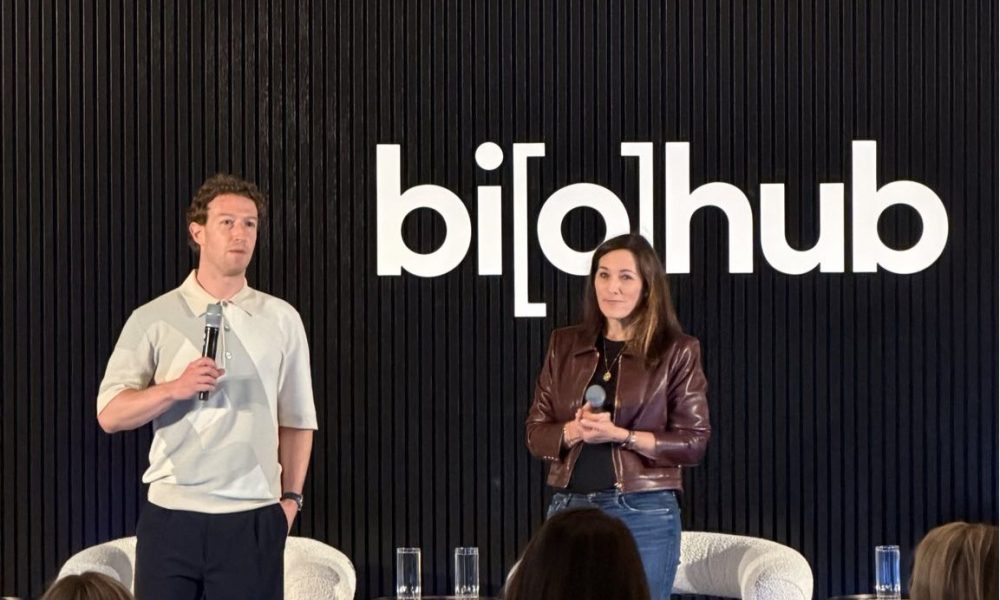
On October 7 (US time), Biohub, the nonprofit research organization founded by Mark Zuckerberg and Priscilla Chan, announced a major expansion of its Virtual Biology Initiative together with the US Department of Energy (DOE), the National Institutes of Health (NIH) and several technology companies. The partners have committed a combined 1.8 billion dollars in funding, data, computing power and measurement technology, which the organizers describe as the largest coordinated investment in AI-ready biological data to date.
Among the new funders, Google DeepMind, Meta and Isomorphic Labs, the AI drug discovery company under Alphabet, are jointly investing 300 million dollars. The DOE plans to invest more than 500 million dollars over the next five years in laboratory measurement, biological data collection, modeling and computing, drawing on US supercomputers, electron microscopy and automated laboratories. The NIH will connect biomedical datasets and research infrastructure built with more than 500 million dollars in previous federal investment, and will work with Biohub to standardize these resources for AI training.
Biohub committed 500 million dollars when it launched the initiative in April. Of that amount, 400 million dollars will fund in-house development of measurement, imaging and molecular engineering technologies, and 100 million dollars will support external research. Participating research organizations include the Allen Institute, the Broad Institute, the Gladstone Institutes, the Wellcome Sanger Institute, the Human Cell Atlas and the Human Protein Atlas, with partners such as NVIDIA and the Arc Institute also on board.
The initiative targets one core problem: data. Large language models learned from vast amounts of text that already existed online, but AI models of biology depend on experimental data that researchers usually have to generate from scratch. The partners will measure at scale how different cell types respond to interventions such as drugs and genetic changes, turn the results into open datasets, and use them to train “virtual cell” models that predict cellular behavior. With such models, scientists could screen candidates digitally first and send only the most promising options to real laboratory and clinical studies. Alex Rives, Head of Science at Biohub, said an accurate predictive model of biology could dramatically speed up scientific discovery by letting scientists run experiments digitally.
According to Reuters, the partners aim to build a predictive virtual cell within five years, and expect to release the first dataset in about 12 months.
The 1.8 billion dollar figure does not represent new cash alone, as it also counts existing data, computing resources and technologies. The initiative has not yet produced a working universal virtual cell; the money pays for the data foundation needed to train and validate such models. Some observers also point out that it remains unproven whether simply adding more data will produce better single-cell models.
For AI companies, biological data is becoming a training resource as strategic as text and code. The move by Meta and Google shows that the AI arms race among tech giants has now reached the life sciences.